Type of Foundations
Building foundations are one of the most essential elements in every construction project, providing a firm base for a structure to be built on top of.
Even though they’re not visible when the construction process is complete, it’s vital that foundations are built using high-quality materials, such as concrete. If low-quality materials are used, then the integrity of the entire structure is at risk and it’ll be incredibly dangerous to reside in.
One of the major jobs of foundations is to evenly distribute the weight of the structure in order to keep it strong and sturdy.
With this in mind, selecting the right building foundations for the job at hand is extremely important.
In this article, the team here at Concrete Supply UK will take a look at the different types of foundations and their suitabilities. – Read on to find out more.

What are the different types of foundations?
Typically, there are two main types of foundations that are commonly used in the UK. These are shallow foundations and deep foundations. Within both types, there are different variations so let’s take a look at the different options and the benefits they offer.
Shallow foundations
Usually reserved for smaller and lighter buildings, shallow foundations are known for offering more width than depth which makes them more cost-effective and often easier to build.
They are more common in residential homes and when the lowest part of the structure extends less than six feet deep, and the earth below it has sufficient weight-bearing capacity, then shallow foundations will usually be the preferred choice.
There are a whole host of different shallow foundations including:
Mat or raft foundations
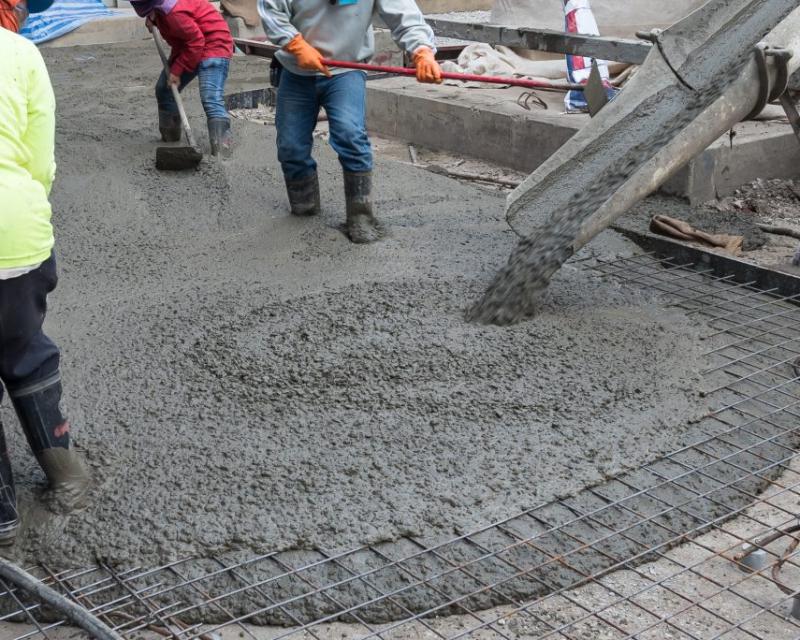
With mat, or raft, foundations, large rectangular or circular slabs are used to control differential settlement. This will often be the case if the soil or ground is known to have a poor bearing capacity or if the structure’s load is widely distributed across a wide surface area.
They are also designed to reduce uneven settlements and ensure the stability of a structure.
They are commonly found in basements or small commercial buildings.
Spread footings
Spread footings, also sometimes referred to as isolated or individual footings, are one of the most economical and commonly used shallow foundations.
In these instances, the base is made wider than the top of the foundation in order to distribute the load throughout the area.
Usually, these are used in residential buildings, walls and masonry columns.
Wall footings
Another main type of shallow foundation is a wall footing or strip footing.
These types of foundations are longer and narrower compared to many other options and they’re usually selected when supporting load-bearing walls in buildings where the column space isn’t particularly wide.
Basement foundations
Basement foundations are also a type of shallow foundation that is commonly used. Constructed in environments where a basement is also being built, they help distribute a building’s weight evenly and are specifically designed to protect it from moisture and water.
Unlike conventional shallow foundations, however, basement foundations are fully submerged in the soil in order to create a working space below ground level.
These foundations can take longer to construct as they need heavy-duty equipment and diggers, excavators and cranes to move the soil.
Crawl space foundations
Compared to other shallow foundations, crawl space foundations tend to be slightly deeper.
They leave a small amount of space, around three to four feet high under the house, to provide access to drainage pipes, plumbing and other elements.
As well as making it easier to access these utilities, crawl spaces also help to keep houses cooler in warmer climates which is why they tend to be more popular in the United States than here in the UK.
While they can cost less than other shallow foundation types, you will need insulation and moisture control elements.
Deep foundations
In contrast to shallow foundations, deep foundations are used to transfer the weight of much larger structures such as skyscrapers, bridges, shopping centres and other larger commercial buildings. Deep foundations transfer the weight down to a depth of 250 feet, or further.
Let’s take a look at some of the most popular deep foundation options:
Pile foundations
The most common type of deep foundations is pile foundations.
They are made from long, slender cylinders that are built from durable materials. As they are inserted into the ground, these foundations will transfer the load to the desired depth ensuring the entire structure is protected and safe.
The ground conditions for pile foundations need to be of a certain standard, including having a layer of weak soil at the surface, high groundwater levels, deep drainage systems and more.
Usually, pile foundations will be chosen for bridges and high-rise buildings.
Caisson foundations
Caisson foundations use prefabricated hollow boxes, or cylinders, that have been built above ground level and are then submerged in water.
These structures are used if keeping a structure watertight is important which is why they are often built for piers, bridges, concrete dams and ship repair projects.
Usually, they will be built near the surface of the ground before being sunk to the desired depth. Engineers will create a hole in the ground and excavate the material before filling it with concrete. They can also be drilled into bedrock or other soil layers.
Buoyant foundations
If structures are being built to ‘float’ or above water, buoyant foundations act as floating substructures. Also commonly referred to as floating raft foundations, hollow box foundations or compressed foundations, the main purpose is to reduce the load intensity over soil.
They are normally used in areas of high-risk flooding areas where new homes are being built.
Need concrete for your foundations?
At Concrete Supply UK, we’re comprehensive concrete specialists who regularly supply and deliver leading types of concrete to customers nationwide. This includes domestic and commercial concrete mixes that can be used for foundations.
We’ll take the time to get to know you and your needs before providing you with products that are specifically formulated for your needs. For more information, get in touch with our team today.